Quick answer
The AI concept appears to be aiming for a Mediterranean/Southwestern drought-tolerant landscape. The palms most closely resemble Mediterranean fan palms (Chamaerops humilis), while the smaller architectural plants resemble combinations of red yucca (Hesperaloe parviflora) and artichoke agave (Agave parryi). Because the concept is AI-generated, these identifications are approximate rather than botanical specifications. The good news is that close real-world equivalents can perform very well in Highland when planted with appropriate drainage, spacing, and irrigation.
Visual comparison
| Photo | Plant / Palm | Highland fit | Approx. mature scale |
|---|---|---|---|
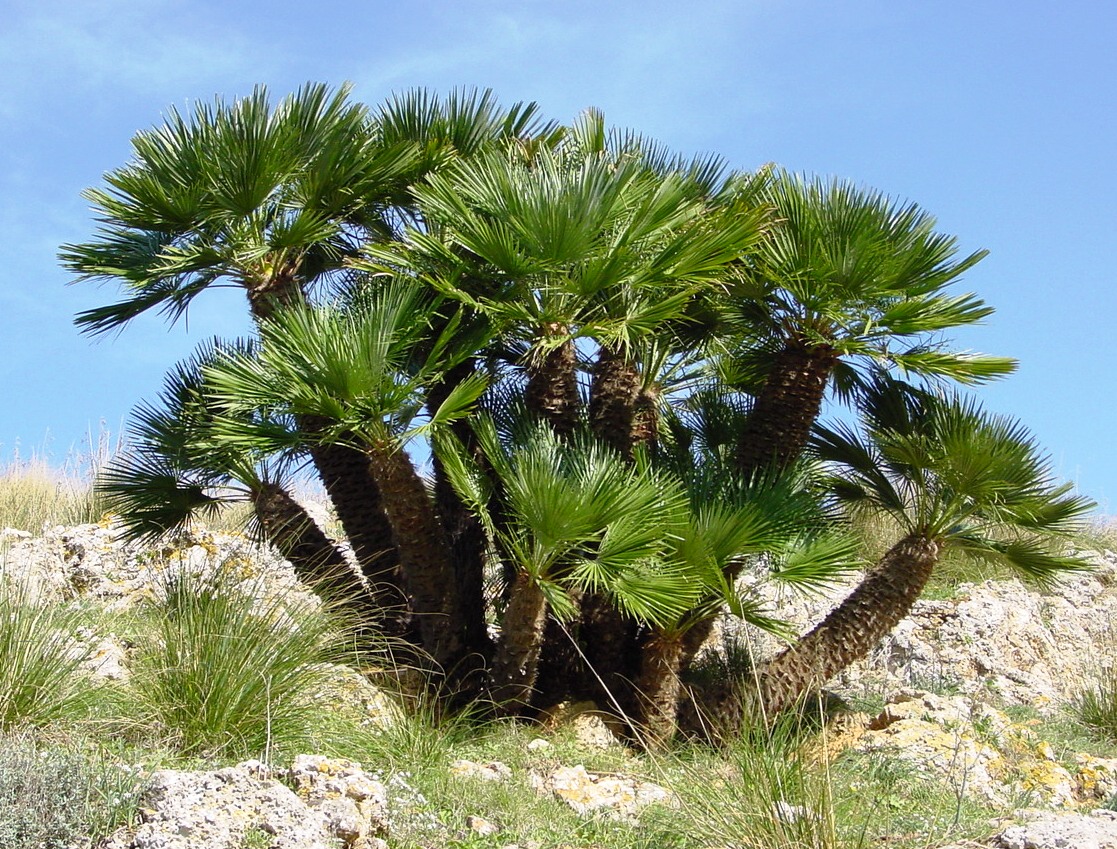 | Mediterranean Fan Palm Chamaerops humilis | Excellent | About 10–20 ft. tall/wide as an unmanaged clump |
 | ‘Vulcano’ Mediterranean Fan Palm Chamaerops humilis ‘Vulcano’ Representative species photo | Excellent | Compact cultivar; substantially smaller than the typical species |
 | Red Yucca Hesperaloe parviflora | Excellent | About 2–3 ft. foliage height × 3–5 ft. wide |
 | Brakelights® Red Yucca compact Hesperaloe parviflora cultivar Representative species photo | Excellent | About 2–3 ft. tall/wide in foliage |
 | Artichoke / Parry’s Agave Agave parryi var. truncata | Excellent with good drainage | About 2–3 ft. tall × 2–3 ft. wide |
 | Beaked Yucca Yucca rostrata | Excellent | About 6–15 ft. tall; 4–6 ft. crown |
 | Desert Spoon Dasylirion wheeleri | Excellent | Commonly about 4–5 ft. across |
What the AI concept appears to show
The image provided for this front-yard concept is an AI-generated visualization, so individual leaves, trunks, and growth habits may combine characteristics of more than one real species. It should be treated as a design reference rather than a botanical planting plan.
The short, clustered fan palms most closely resemble Mediterranean fan palm (Chamaerops humilis). The smaller spiky plants appear to borrow from drought-tolerant Southwest plants such as red yucca (Hesperaloe parviflora) and artichoke agave / Parry’s agave (Agave parryi). The overall style is a low-water Mediterranean/Southwestern composition of compact palms, sculptural rosettes, decorative rock, and boulders.
What USDA Zones 9b and 10a mean for Highland
The USDA Plant Hardiness Zone system is based on the average annual extreme minimum winter temperature. A zone number does not tell us everything about a plant’s suitability—it primarily helps us judge winter cold tolerance.
- Zone 9b: approximately 25°F to 30°F average annual extreme minimum.
- Zone 10a: approximately 30°F to 35°F average annual extreme minimum.
Highland sits around the 9b–10a range depending on exact neighborhood, elevation, and microclimate. For landscape planning, we prefer to use the colder end of that range as a conservative baseline. That gives plants a better safety margin during an unusually cold winter.
Highland also experiences hot, dry summers and intense inland sun. Local geology includes alluvial deposits of gravel, sand, and silt, but developed residential lots can contain compacted fill, disturbed soil, or localized drainage problems. For the plants below, drainage and irrigation management are just as important as the USDA zone. Most of these species tolerate heat and drought very well once established, but several perform poorly if their root zones stay constantly wet.
Seven plant and palm options that fit the design
1. Mediterranean Fan Palm — Chamaerops humilis
Highland fit: Excellent. This is one of the strongest matches to the AI rendering and one of the most climate-appropriate palms for an Inland Empire front yard. It handles full sun, extreme heat, drought, wind, and winter cold far below what Highland normally experiences.
Typical mature scale: approximately 10–20 ft. tall and wide when allowed to develop as a clump. It can be maintained smaller with selective removal of suckers.
2. Mediterranean Fan Palm ‘Vulcano’ — Chamaerops humilis ‘Vulcano’

Photo note: the image above shows the species as a visual reference; ‘Vulcano’ is a compact cultivar of the same palm.
Highland fit: Excellent. ‘Vulcano’ is especially attractive for this concept because it has a denser, more compact habit and greatly reduced petiole armament compared with typical Mediterranean fan palm. It more closely reproduces the short, full palm silhouette shown in the AI rendering.
Important: cultivar availability varies. We would verify nursery availability before including ‘Vulcano’ as a specified contract plant.
3. Red Yucca — Hesperaloe parviflora
Highland fit: Excellent. Red yucca is highly adapted to inland heat, sun, winter cold, and summer drought. The narrow arching leaves give the same starburst effect suggested by several plants in the concept, and the flower stalks add seasonal color that attracts hummingbirds.
Typical mature scale: roughly 2–3 ft. tall in foliage and about 3–5 ft. wide, with flower stalks extending higher.
4. Brakelights® Red Yucca — compact Hesperaloe parviflora cultivar

Photo note: the image above represents the species; Brakelights® is the compact, deep-red-flowering cultivar.
Highland fit: Excellent. This is one of our favorite options for the smaller accent plants. It keeps a more compact footprint than the standard species, produces strong red flowers, and is well suited to hot inland landscapes.
Typical mature scale: approximately 2–3 ft. tall and wide in foliage.
5. Artichoke Agave / Parry’s Agave — Agave parryi var. truncata
Highland fit: Excellent with good drainage. Its compact blue-gray rosette is very close to the sculptural agave-like forms in the AI image. It tolerates heat, drought, and temperatures much colder than Highland normally experiences.
Typical mature scale: approximately 2–3 ft. tall and 2–3 ft. wide. Because the leaves have sharp marginal teeth and a terminal spine, it should be kept away from walkways, play areas, and places where someone could brush against it.
6. Beaked Yucca — Yucca rostrata

Highland fit: Excellent. Beaked yucca is a strong choice when the design needs one taller architectural specimen. It handles intense sun, heat, drought, and winter cold well and develops a distinctive trunk with a rounded blue-green crown.
Typical mature scale: approximately 6–15 ft. tall with a crown around 4–6 ft. wide. It is slow growing and is normally used as a focal plant rather than repeated in large quantities.
7. Desert Spoon — Dasylirion wheeleri
Highland fit: Excellent. Desert spoon thrives in hot, dry inland conditions and provides a dramatic spherical form similar to some of the larger spiky plants shown in the rendering.
Typical mature scale: commonly about 4–5 ft. across, with older specimens developing a trunk. Its narrow leaves have sharp teeth, so it needs generous clearance from pedestrian areas.
Pros and cons at a glance
| Plant | Advantages | Tradeoffs |
|---|---|---|
| Mediterranean fan palm | Excellent heat, cold and drought tolerance; classic compact palm appearance; very durable. | Standard form suckers into a wider clump; sharp petiole spines; needs periodic pup and frond management. |
| ‘Vulcano’ Mediterranean fan palm | Closest palm match to the concept; compact, dense form; greatly reduced spines; low water. | Slower and often more expensive; availability can be limited. |
| Red yucca | Extremely climate-adapted; low water; softer than most agaves; colorful flowers and hummingbird value. | Can widen into a substantial clump; spent flower stalks need periodic removal. |
| Brakelights® red yucca | Compact footprint; deep-red flowers; excellent heat and drought tolerance; very useful near smaller planting areas. | Usually costs more than standard red yucca; still needs occasional flower-stalk cleanup. |
| Artichoke agave | Beautiful blue architectural rosette; extremely drought and cold tolerant; excellent scale for rock landscapes. | Sharp teeth and terminal spine; may produce pups; the mother rosette is monocarpic and eventually flowers once and dies. |
| Yucca rostrata | Exceptional focal specimen; blue-green architectural crown; highly heat, drought and cold tolerant. | Eventually taller than the AI image suggests; slow-growing specimen plants can be relatively expensive. |
| Desert spoon | Very tough; symmetrical architectural form; excellent heat, drought, wind and frost tolerance. | Much wider at maturity than it appears when young; serrated leaves require substantial setback from walkways. |
Our professional suggestion for this front yard
For the closest real-world interpretation of the AI design while keeping long-term maintenance and mature size in mind, our preferred palette would start with ‘Vulcano’ Mediterranean fan palm if it is available from our nurseries. If it is not, a carefully selected standard Mediterranean fan palm is a very strong substitute.
For the smaller architectural plants, Brakelights® red yucca is an excellent repeating accent because it stays relatively compact, tolerates Highland’s climate, and adds seasonal color without the rigid terminal spine of an agave. We would then use artichoke agave selectively, positioned farther from sidewalks and pedestrian areas where its sharp tips are not a concern.
A Yucca rostrata can be used as a taller focal specimen if a stronger vertical element is desired. Desert spoon is also highly suitable, but only where its eventual width and serrated foliage can be given enough clearance.
We would not automatically copy the exact number of plants shown in an AI rendering. Young nursery plants can look appropriately spaced on installation day but become badly overcrowded as they mature. Once the preferred species and quantities are selected, we can advise on final spacing and container sizes.
Planting-zone construction matters
The artificial-turf base and the planting beds should be treated as separate systems. Compacted recycled Class II road base should not be carried through the root zones of the palms and accent plants. Planting areas should retain suitable soil volume and receive appropriately designed drip irrigation. The final planting depth, irrigation frequency, and any drainage correction should be based on actual field conditions.
Other palms that can grow successfully in Highland
Mexican blue palm (Brahea armata) and Pindo palm (Butia odorata) are both capable of performing well in hot inland Southern California climates and tolerate winter temperatures below Highland’s normal range. We are not placing them among the primary recommendations because they mature into substantially larger palms and create a different visual effect than the low, compact palms shown in the AI concept. They remain good options if a larger long-term specimen is desired.
Decision / Next Step
The plant portion is intentionally not priced yet. The next step is to decide which plants you actually want and how you would like them supplied.
Please reply with your preferences:
- Which plant or palm varieties do you like? You can choose any combination from the seven options above.
- How many of each would you like? If you prefer, choose the plants first and ask us to recommend quantities and spacing afterward.
- How would you like the plants supplied?
- Option A: You purchase the plants and have them ready at the property, and Kreative Gardens plants them.
- Option B: Kreative Gardens sources, purchases, delivers, and plants them for you.
- Would you like the decorative boulders included? The AI concept shows a couple of boulders among the plants. Let us know whether you would like Kreative Gardens to source and install similar boulders as part of the planting area.
After the plant types, quantities, supply option, and boulder preference are confirmed, we can prepare the additional pricing.
Project evidence
How this project was evaluated and built
Original challenge
Work performed
Materials and systems used
Outcome
Key takeaways
- The AI rendering is a design reference, not an exact botanical planting plan.
- Mediterranean fan palm, red yucca, artichoke agave, Yucca rostrata, and desert spoon are all strong climate matches for Highland when correctly sited and drained.
- ‘Vulcano’ Mediterranean fan palm and Brakelights® red yucca are particularly strong choices when a compact mature size is important.
- Agaves and desert spoons should be kept away from pedestrian edges because of sharp foliage.
- Final quantities should be based on mature plant dimensions, not only how full the yard looks on installation day.
- Planting zones should remain true soil/root zones with appropriate drip irrigation rather than compacted artificial-turf road base.
Frequently asked questions
Questions homeowners commonly ask
Are the plants in the AI image exact species?
No. AI-generated landscape images often blend traits from multiple plants. The identifications on this page are the closest practical real-world equivalents, selected both for visual similarity and for their suitability to Highland.
Does USDA Zone 9b or 10a guarantee a plant will thrive?
No. USDA zones primarily describe winter minimum temperatures. Summer heat, drainage, irrigation, soil condition, reflected heat, and mature plant size also matter.
Can Kreative Gardens purchase the plants?
Yes. You may either purchase the plants yourself and have Kreative Gardens plant them, or ask Kreative Gardens to source, purchase, deliver, and install them. Nursery availability and plant size affect final pricing.
Can the boulders shown in the concept be added?
Yes. If you want boulders similar to those shown in the AI concept, tell us and we can include sourcing and placement in the additional scope.
Sources and further reading
Research used for this resource
Climate, soil, and plant references
- USDA Plant Hardiness Zone Map — explains the winter-minimum-temperature basis of USDA zones.
- City of Highland environmental/geologic information — local alluvial setting and soil/geologic context.
- Waterwise Garden Planner: Mediterranean Fan Palm.
- Santa Barbara Beautiful: Chamaerops humilis and ‘Vulcano’.
- Waterwise Garden Planner: Red Yucca.
- Waterwise Garden Planner: Brakelights® Red Yucca.
- Waterwise Garden Planner: Artichoke Agave.
- Waterwise Garden Planner: Yucca rostrata.
- Waterwise Garden Planner: Desert Spoon.
- UC Cooperative Extension Palm Information Chart — includes Mediterranean fan, Mexican blue, and Pindo palms for interior-valley and desert conditions.
- Cal Poly SelecTree: Pindo Palm.
Plant photo credits
The plant photographs are visual references from Wikimedia Commons and remain subject to their respective licenses. Mediterranean fan palm: tato grasso, CC BY-SA 2.5. Chamaerops representative image: Giancarlo Dessì, CC BY-SA 3.0. Red yucca: Skarz, CC BY-SA 4.0. Hesperaloe representative image: David J. Stang, CC BY-SA 4.0. Artichoke agave: Nesnad, CC BY 4.0. Yucca rostrata: c299792458, CC BY-SA 3.0. Desert spoon: Daderot, CC0.
Practical next step
Ready to choose the planting package?
Choose the plants you like, tell us how many of each you want (or ask us to recommend quantities), decide who will supply the plants, and tell us whether you would like the decorative boulders included.